 how-to
How to Prepare for a Divorce Court Hearing: Step-by-Step
Table of Contents
- Step 1: Understand What Kind of Divorce Hearing You Have
- Step 2: Review Your Case Facts and Identify the Legal Issues
- Step 3: Build Your Divorce Hearing Checklist
- Step 4: Know What to Bring to a Divorce Hearing
- Step 5: Organize Your Trial Notebook and Evidence
- Step 6: Decide Which Witnesses to Call
- Step 7: Prepare to Testify and Answer the Questions a Judge Asks at a Divorce Hearing
- Common Mistakes and What to Do If You Are Self-Represented
- Frequently Asked Questions
Last Updated: October 18, 2026
Step 1: Understand What Kind of Divorce Hearing You Have
A divorce hearing is any scheduled court appearance where a judge decides an issue in your case, and the type of hearing on your calendar changes almost everything about how you prepare.
At The Law Office of Thomas K. Mallon, LLC, we tell clients the same thing: the word "hearing" covers several very different events. Know which one is on your calendar before you do anything else.
How Preparation Changes by Hearing Type
| Hearing type | What the judge decides | What you should bring | How to prepare |
|---|---|---|---|
| First appearance / scheduling conference | Calendar, deadlines, service issues, temporary orders | Notice of hearing, proof of service, proposed scheduling order | Confirm service was proper, know your availability, bring a short list of issues you want addressed |
| Temporary orders hearing | Short-term support, custody, who stays in the home, attorney fees | Current income records, recent bank statements, proposed parenting schedule | Focus on immediate needs and the last 12 months of financial records; keep it short |
| Status conference | Settlement progress, discovery disputes, trial readiness | Status report, list of unresolved issues, discovery log | Be ready to state what is settled and what is not, and what you need from the other side |
| Evidentiary hearing (motion) | A specific disputed issue, such as a discovery motion or a request to exclude evidence | Exhibits tied to that one issue, witness list, legal authority | Narrow your presentation to the single issue; bring only the documents that prove it |
| Final trial / final hearing | The divorce itself, property, debts, custody, support, or approval of a settlement | Full trial notebook, exhibit index, witness list, proposed orders | Build the full record: every exhibit, every witness, and a written outline of your testimony |
A temporary hearing moves fast and focuses on immediate needs. A final hearing digs into the full record. A status conference is mostly procedural and can be short if you come organized. Treating a status conference like a final trial wastes the court's time; treating a final trial like a status conference can cost you the chance to present evidence.
Remote and Hybrid Court Hearings
Many courts now allow video or hybrid appearances, and the preparation rules do not relax just because you are on a screen. A remote hearing still requires the same documents, the same quiet space, and the same dress code as an in-person one.
Test your camera and microphone a day early. Have your paperwork in front of you, not on a second screen you'll fumble with. Courts can and do reschedule when technology fails.
Step 2: Review Your Case Facts and Identify the Legal Issues
Start with the facts, not the emotions. Then list the legal issues the judge will actually decide.
Most divorce cases turn on a handful of issues:
- Property division
- Debt allocation
- Child custody and parenting time
- Child support
- Spousal support
For each issue, write one sentence stating your position and one sentence stating what proof you have. If you can't fill in the proof column, that's your homework.
Review your case facts against the court filings. A common mistake is walking in with a story that contradicts your own paperwork. Judges notice.
Step 3: Build Your Divorce Hearing Checklist
A divorce hearing checklist keeps you from forgetting the small things that sink a case. Build it early, then work backward from your court date.
Here's a practical checklist you can adapt:
- Confirm the hearing date, time, and location
- Review all court filings and the opposing side's documents
- Gather financial records and exhibits
- Assemble your trial notebook
- Confirm witnesses and their availability
Two Weeks Out, One Week Out, and the Day Before
Two weeks out: finish gathering documents, confirm witnesses, and review the applicable law with your attorney if you have one.
One week out: organize your trial notebook, practice direct examination answers, and print everything. Don't rely on a phone battery in a courtroom.
The day before: lay out your clothes, confirm the courthouse location and parking, charge your devices, and get a full night's sleep.
Step 4: Know What to Bring to a Divorce Hearing
Bring originals plus two copies of everything: one for the judge, one for the opposing attorney. Knowing what to bring to a divorce hearing is half the battle.
Your core documents usually include:
- Court filings and the notice of hearing
- Financial disclosure statements
- Recent tax returns
- Bank and credit card statements
- Pay stubs and income records
Financial Records and Exhibits
Financial records do the heavy lifting in most divorce hearings. They prove income, assets, and debts better than any speech.
Organize statements chronologically. Highlight the relevant lines. Don't hand a judge a shoebox of receipts and expect them to sort it out.
Prepare exhibits with clear labels. Number each one and keep a master list so you can find it fast when asked.
Step 5: Organize Your Trial Notebook and Evidence
A trial notebook is a single binder that holds everything you need in the order you'll need it. It's the difference between calm and chaos.
Schedule Your Free Consultation →
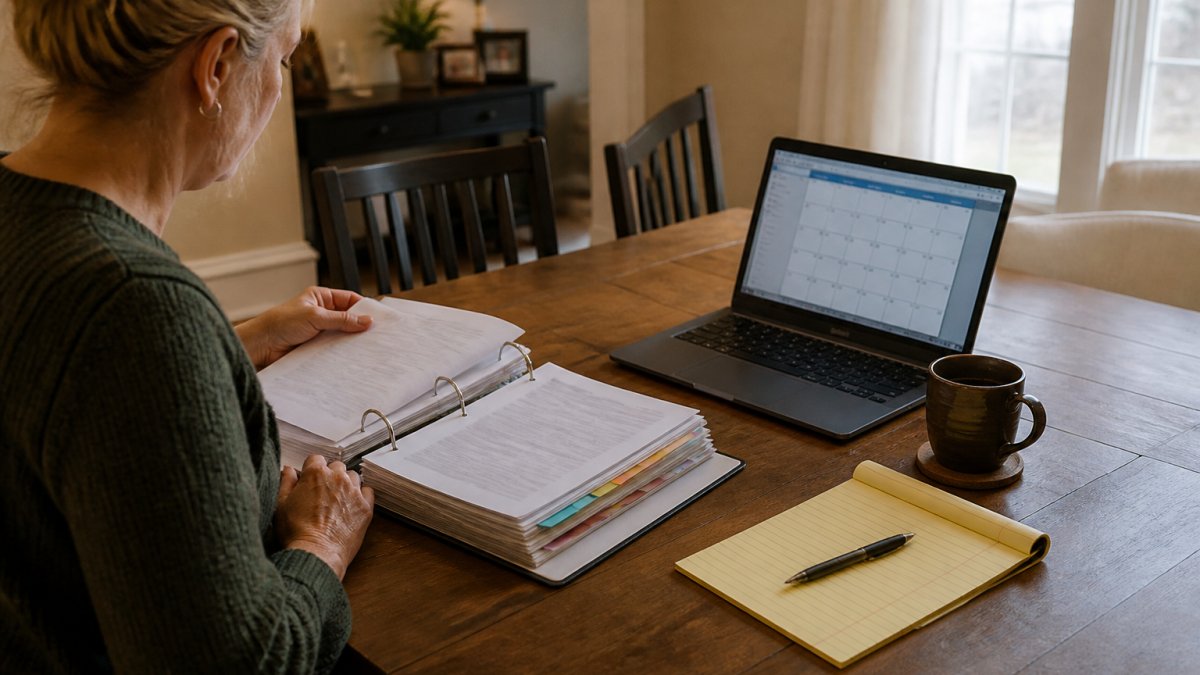
Build it with tabbed sections:
- Tab 1: Hearing notice and court filings
- Tab 2: Exhibit index and exhibits
- Tab 3: Financial records
- Tab 4: Witness list and notes
- Tab 5: Your testimony outline
Keep one master copy for yourself and a clean copy for the court. Document organization isn't busywork. It shows the judge you take the process seriously.
Step 6: Decide Which Witnesses to Call
Fewer witnesses, better prepared, usually beats a long parade of vague ones. Each witness should prove a specific fact you can't prove another way.
Ask yourself for each person:
- What exact fact will they testify to?
- Do they have firsthand knowledge?
- Can I prove this with a document instead?
If a document proves it, use the document. Witnesses are for things only a person can establish, like parenting routines or a party's conduct.
Talk to your witnesses before the hearing. Walk them through what they'll be asked and remind them to answer truthfully and stay calm.
Step 7: Prepare to Testify and Answer the Questions a Judge Asks at a Divorce Hearing
Testimony is where preparation pays off. The questions a judge asks at a divorce hearing usually focus on income, assets, debts, the children, and whether your paperwork is accurate.
Expect questions like:
- What is your current income and how is it documented?
- What assets and debts do you and your spouse share?
- What parenting arrangement are you proposing, and why?
- Have you been truthful in your financial disclosure?
How to Prepare to Testify in Divorce Court
Learn how to prepare to testify in divorce court by practicing out loud, not just reading. Answer each likely question in two or three sentences. Short answers are harder to trip up.
On the stand:
- Answer truthfully, every time
- Stay calm, even under cross-examination
- Pause before answering instead of rushing
- Say "I don't know" when you don't know
Direct examination is your side asking questions. Cross-examination is the opposing attorney testing your answers. In both, keep your voice steady and your answers consistent with your documents.
Common Mistakes and What to Do If You Are Self-Represented
The biggest mistake is treating the hearing like an argument to win rather than a process to follow. Judges want organized facts, not drama. The second biggest mistake is assuming the judge will fill in the gaps for you, especially if you are representing yourself.
Other common errors:
- Contradicting your own court filings
- Bringing disorganized documents
- Losing your temper under cross-examination
- Forgetting to confirm whether the hearing is remote
- Talking over the judge or opposing counsel
A Self-Represented Path, Step by Step
If you are self-represented, you have the right to represent yourself, but the court holds you to the same rules as an attorney. That means the procedural steps below are not optional.
- Confirm your filing and service. Make sure your petition or response was filed with the clerk and that the other side was served according to the court's rules. Bring proof of service to the hearing.
- Read the local rules. Court rules on evidence, exhibit exchange, and deadlines are usually posted on the court's website. The court rules and self-help resources from the Maryland Judiciary are a good example of what to look for.
- Disclose and exchange exhibits. Most courts require you to share exhibits with the other side before the hearing. Bring a certificate of service or a log showing what you sent and when.
- Prepare a proposed order. Many judges appreciate a short written order stating what you are asking for. It saves time and shows you understand the process.
- Know how to present evidence. You will need to identify the document, explain what it is, and ask the judge to admit it. Practice this out loud before the hearing.
The legal information on divorce and family law from the Maryland People's Law Library can help you understand the process, and the American Bar Association's resources on representing yourself explains what self-representation involves.
Accessibility, Language, and Safety Needs
If you need an interpreter, a disability accommodation, or a safety plan for a protective order situation, contact the clerk well before the hearing. Don't wait until the morning of. Courts can arrange separate waiting areas or remote appearance when safety is a concern.
Frequently Asked Questions
What should I not say during a divorce hearing?
Avoid guessing, arguing with the opposing attorney, or volunteering information the judge did not ask for. Answer only the question asked, then stop. Do not speak badly about your spouse or make promises about the future. If you do not know an answer, say so plainly rather than estimating. If you do not understand a question, ask for it to be repeated. Staying calm and answering truthfully protects your credibility, which matters in every divorce hearing.
What does a judge ask you at a divorce hearing?
A judge typically confirms your name and address, asks whether you reviewed your court filings, and asks about the facts in your case: date of separation, grounds for divorce, children, income, assets, and debts. The judge may ask whether you and your spouse reached any agreement and whether you understand what you are asking the court to approve. Answer each question directly and keep responses short. Review your financial disclosure before the hearing so your answers match your documents.
How do I organize evidence for a divorce hearing?
Use a trial notebook with tabs for each issue: custody, support, property, and debts. Number every exhibit and keep three copies: one for the judge, one for the opposing attorney, and one for yourself. Put financial records, tax returns, and bank statements in date order. Bring the originals of key documents and a copy of your court filings. A divorce hearing checklist helps you confirm nothing is missing before you leave for the courthouse.
What should I do the day before a divorce hearing?
Confirm the time, courtroom, and whether the hearing is remote. Lay out your clothes, pack your trial notebook and exhibits, and charge your devices. Re-read your financial disclosure and practice your answers out loud. Arrange childcare and transportation so you arrive early. Avoid discussing the case on social media. Get a full night's sleep. If you are self-represented, check the court's website for rules on remote hearings and accessibility needs.